Task Automation Vs. Workflow Automation: What is the Difference

According to McKinsey & Company, in nearly 60% of occupations, at least one-third of activities can be automated. This shows that automation is already embedded across everyday work.
But as automation becomes more common, a deeper question emerges: what exactly is being automated?
Not all automation works at the same level. That difference changes what the system is actually capable of handling.
In this blog, we break down the difference between task automation and workflow automation, and why that distinction is becoming more relevant in how systems are designed and used.
What is Task Automation?
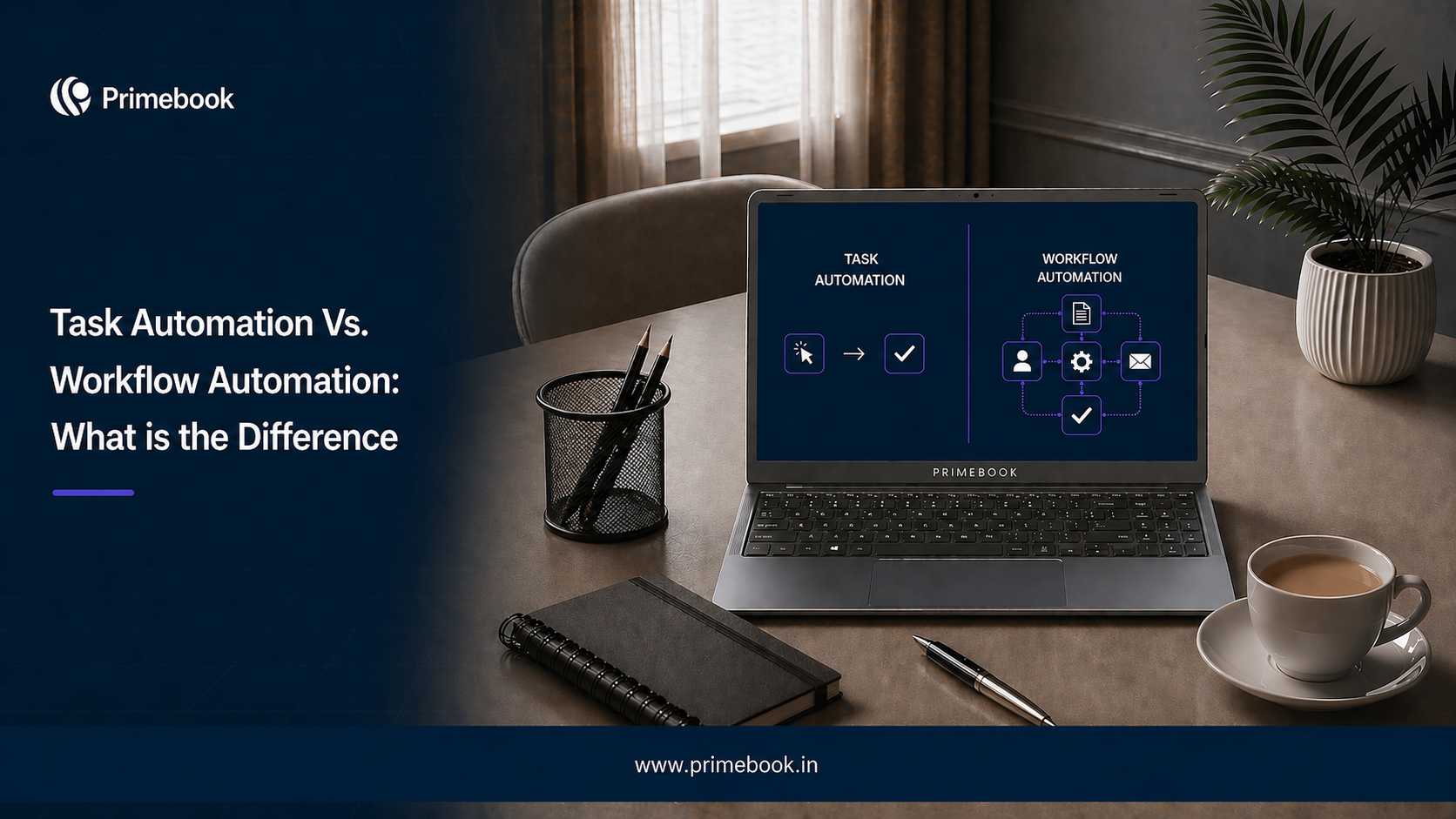
Task automation focuses on completing individual actions within a larger flow.
These actions are usually repetitive and follow a defined pattern, making them easy to execute without manual effort.
For example:
-
Sending an automatic email response
-
Formatting data in a spreadsheet
-
Generating a report from a template
Each action is completed in isolation. Once it is done, the system does not continue the work further. You still decide what needs to be done next and how different actions connect.
Task automation improves how individual actions are performed, but it does not remove the need to manage the overall flow.
Also Read: How to Automate Repetitive Tasks Using AI in 2026
What is Workflow Automation?
Workflow automation focuses on how work moves from one step to the next until a defined outcome is completed.
Instead of stopping after a single action, the system continues the sequence required to carry the work forward.
For example:
-
A lead is received → evaluated → a response is sent → follow-up is scheduled → status is updated
-
A job application is created → tailored → submitted → tracked
In these cases, the system does not pause after completing one step. It proceeds through the sequence as part of the same execution. This changes how the work is managed.
You are no longer deciding what happens after each step or manually moving between actions. The system handles the progression, ensuring that the process continues until completion.
Workflow automation shifts the focus from executing individual actions to ensuring that the work itself is completed.
Also Read: How to Automate Job Applications Using AI in 2026
Key Differences Between Task Automation and Workflow Automation
-
Where decision-making happens
With task automation, decisions remain distributed across the process, requiring input at multiple points. Workflow automation centralises this by interpreting what needs to be done and carrying it forward.
-
How work is initiated
Task automation is triggered step by step, often requiring repeated inputs. Workflow automation begins from a defined objective and builds the process around it.
-
How context is handled
Task automation works with a limited, step-specific context. Workflow automation operates with a broader context, allowing actions to adapt based on the overall goal.
-
How consistency is achieved
In task automation, consistency depends on how reliably each step is executed. In workflow automation, consistency comes from the process being handled as a single system.
-
How scale is managed
Task automation scales individual actions. Workflow automation scales entire processes without increasing manual involvement.
Also Read: How to Send Emails Without Manual Work in 2026
Why This Difference Matters in 2026
As more work is done through software, how work is structured starts to shape how people think about it.
When actions are handled one at a time, the focus stays on completing the next step. The outcome is built gradually, but it is not defined upfront.
When work is handled as a complete process, the starting point changes. The outcome is defined first, and everything else follows from it.
This changes how work is approached; not as a series of actions to manage, but as an outcome to be achieved.
Also Read: The Future of Workflow Automation
In a nutshell, as automation becomes more common, the difference lies in how predictable work becomes over time. When work depends on managing steps, outcomes can vary based on how each instance is handled. When work is structured as a process, the result becomes more consistent across repetitions. Systems such as Operator AI build on this by reinforcing that consistency as work scales.